2026 Solar Policy Update
DCR vs Non-DCR Solar Panels: 2026 Policy Update for Commercial & Industrial Rooftop Solar Projects
India’s rooftop solar industry is undergoing a major transformation in 2026. If you are planning a commercial rooftop solar installation, industrial rooftop solar project, factory solar plant, or large-scale C&I rooftop solar system, understanding the latest DCR vs Non-DCR solar panel regulations is now essential.
Compare Solar EPC Contractors
From June 1, 2026, the Government of India has significantly tightened regulations around rooftop solar installations by restricting the use of Non-DCR solar panels for most commercial, industrial, and government-supported projects.
This policy aims to strengthen domestic solar manufacturing, reduce import dependency, and support the Make in India initiative. However, for project owners, EPC contractors, builders, factories, and industries, this also means:
- Higher solar project costs
- Limited panel availability
- Stricter ALMM compliance
- Faster decision-making requirements
- Greater importance of choosing the right EPC partner
In this complete guide, we explain everything businesses need to know about DCR vs Non-DCR solar panels in 2026, including policy updates, cost impact, subsidy rules, ALMM compliance, and how SQFTZ helps businesses compare rooftop solar quotations.
📑 Table of Contents
- DCR vs Non-DCR Solar Panels: An Overview
- The Significance of the 2026 Solar Policy
- Understanding the June 1, 2026 Deadline
- Comparison of DCR and Non-DCR Solar Panels
- Financial Impact on Commercial Rooftop Solar Projects
- ALMM Compliance and MNRE Guidelines
- PM Surya Ghar Subsidy Regulations
- Choosing the Right Solar Panel Type
- The Risks of Delaying Commercial Solar Projects
- Importance of Selecting the Right EPC Partner
- How SQFTZ Helps Commercial Solar Buyers
- Frequently Asked Questions
☀️ DCR vs Non-DCR Solar Panels: An Overview
Understanding the difference between DCR and Non-DCR solar panels is the first step before planning any commercial rooftop solar or industrial rooftop solar project.
What Are DCR Solar Panels?
DCR (Domestic Content Requirement) solar panels are manufactured using:
- Indian-made solar cells
- Modules manufactured in India
These panels comply with government-backed domestic manufacturing policies and qualify for many subsidy-linked solar projects.
What Are Non-DCR Solar Panels?
Non-DCR solar panels use imported solar cells or imported modules. Historically, these panels were cheaper and widely used for commercial rooftop solar projects because of their affordability and availability.
📊 DCR vs Non-DCR Solar Panels Comparison
| Feature |
DCR Solar Panels |
Non-DCR Solar Panels |
| Cell Manufacturing |
India |
Imported |
| Government Compliance |
Yes |
Limited |
| Subsidy Eligibility |
Eligible |
Mostly Ineligible |
| ALMM Requirement |
Mandatory |
Restricted |
| Price |
Higher |
Lower |
| Usage After June 2026 |
Allowed |
Mostly Restricted |
| Best For |
Future-ready projects |
Projects registered earlier |
🏛 Why the 2026 Solar Policy Matters
India’s solar market has relied heavily on imported solar components for years. To strengthen domestic manufacturing and reduce import dependency, the Ministry of New and Renewable Energy (MNRE) has enforced stricter DCR and ALMM requirements.
After June 1, 2026:
- Most commercial rooftop solar projects must use DCR panels
- Industrial rooftop solar systems must use ALMM-approved modules
- Government-supported projects require domestic manufacturing compliance
- Non-DCR flexibility becomes extremely limited
Official Government Resources:
⏳ Understanding the June 1, 2026 Deadline
The government has established strict timelines for projects using Non-DCR solar panels.
| Timeline |
Date |
| Registration Deadline |
March 31, 2026 |
| Commissioning Deadline |
May 31, 2026 |
Projects that fail to meet these timelines must shift to DCR-only panels for compliance.
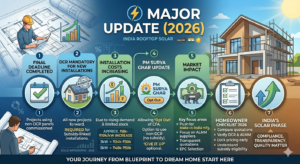
From June 1, 2026 onward, new commercial and industrial rooftop solar projects using Non-DCR modules may not qualify under updated government rules.
💰 Financial Impact of DCR Solar Panels in 2026
One of the biggest concerns for industries and commercial building owners is the increase in solar installation costs due to DCR compliance.
Expected Price Increase
DCR panels may increase rooftop solar project costs by ₹8,000–₹10,000 per kW.
Why Costs Are Rising
Limited domestic manufacturing capacity and increased demand are pushing DCR panel pricing upward.
Supply Chain Impact
Businesses may also face longer procurement timelines and EPC scheduling delays.
Estimated Additional Cost Impact
| System Size |
Additional Estimated Cost |
| 10 kW |
₹80,000 – ₹1,00,000 |
| 50 kW |
₹4 – ₹5 Lakhs |
| 100 kW |
₹8 – ₹10 Lakhs |
✅ ALMM Compliance Explained
ALMM stands for Approved List of Models and Manufacturers.
The Government of India now requires many commercial and industrial rooftop solar projects to use modules listed under ALMM compliance standards.
ALMM ensures:
- Better quality control
- Traceability of solar components
- Government-approved manufacturing standards
- Improved long-term project reliability
Projects using non-compliant modules may face:
- Subsidy rejection
- Net-metering approval delays
- Compliance complications
- Project commissioning issues
🏠 PM Surya Ghar Scheme & DCR Rules
Under the PM Surya Ghar: Muft Bijli Yojana, DCR compliance is now highly important.
DCR Solar Panels
- Eligible for Central Financial Assistance (CFA)
- Preferred for government-supported rooftop solar projects
- Better compliance for subsidy-linked systems
Non-DCR Solar Panels
- Consumers may choose to forgo subsidies
- “Give It Up” option available
- Limited subsidy eligibility
⚡ Which Solar Panel Type Should Businesses Choose?
If Your Project Was Registered Before March 31, 2026
- Non-DCR panels may still be permitted
- Lower upfront installation cost
- Strict execution timelines are necessary
If Your Project Starts After June 2026
- DCR panels are the safer choice
- Better future compliance
- Lower approval risks
- Simplified documentation
- Improved long-term policy alignment
⚠️ Risks of Delaying Commercial Solar Projects
Higher Costs
DCR solar panel prices are expected to rise further as demand increases.
Limited Availability
Domestic manufacturers may experience temporary supply shortages.
EPC Delays
Experienced rooftop solar EPC contractors may become fully booked.
Compliance Risk
Wrong module selection can create approval and commissioning problems.
👷 Why Choosing the Right EPC Partner Matters
In 2026, EPC expertise matters more than ever. A reliable solar EPC company helps businesses with:
- DCR compliance planning
- ALMM module verification
- Net-metering documentation
- Subsidy guidance
- Procurement optimization
- Timeline management
- Commercial rooftop solar execution
Poor planning can cost significantly more than the difference between DCR and Non-DCR panel pricing.
🏢 How SQFTZ Helps Commercial Solar Buyers
SQFTZ helps businesses compare multiple rooftop solar quotations and connect with verified solar EPC contractors across India.
Businesses can use SQFTZ to:
- Compare commercial rooftop solar quotations
- Find verified solar EPC companies
- Understand DCR and ALMM compliance
- Estimate rooftop solar installation cost
- Compare timelines and pricing transparently
- Plan factory rooftop solar projects professionally
Whether you are planning:
- Factory rooftop solar
- Warehouse solar systems
- Commercial building rooftop solar
- Industrial rooftop solar plants
- Office solar projects
SQFTZ simplifies vendor comparison and helps businesses make smarter rooftop solar decisions.
Visit:
https://sqftz.com/
🚀 Future of Rooftop Solar in India
India’s rooftop solar industry is rapidly moving toward:
- Domestic manufacturing growth
- Higher quality standards
- Stronger compliance systems
- Commercial solar expansion
- Energy independence
The 2026 DCR policy is expected to accelerate India’s local solar manufacturing ecosystem and create a more reliable rooftop solar industry for the future.
📌 Conclusion
The 2026 DCR policy update is one of the most important regulatory changes for India’s rooftop solar market in recent years.
Businesses planning commercial rooftop solar or industrial rooftop solar projects can no longer ignore:
- DCR compliance
- ALMM regulations
- EPC expertise
- Project timelines
- Rising installation costs
Companies that plan early will gain the biggest advantage in terms of pricing, compliance, and execution certainty.
If your rooftop solar project is still in the planning stage, now is the right time to:
- Finalize EPC partners
- Lock solar pricing
- Verify module compliance
- Estimate future project costs
- Avoid last-minute policy risks
❓ Frequently Asked Questions
1. What is the difference between DCR and Non-DCR solar panels?
DCR solar panels use India-manufactured cells and modules, while Non-DCR panels use imported components.
2. Are Non-DCR solar panels banned in India?
Non-DCR panels are heavily restricted for many commercial, industrial, and government-supported rooftop solar projects after June 1, 2026.
3. Will DCR solar panels increase project costs?
Yes. Industry estimates suggest DCR panels may increase rooftop solar project costs by ₹8,000–₹10,000 per kW.
4. Is ALMM mandatory for rooftop solar projects?
Yes. Many rooftop solar projects now require ALMM-approved modules for compliance and approvals.
5. Can residential users still use Non-DCR panels?
In some cases yes, but they may need to give up subsidy benefits under PM Surya Ghar schemes.
6. Why is India promoting DCR solar panels?
The government aims to strengthen domestic solar manufacturing and reduce import dependency.
7. How can businesses ensure compliance in 2026?
Businesses should work with experienced EPC contractors, verify ALMM-approved modules, and plan projects early.
8. Are Non-DCR solar panels discontinued from May 31, 2026?
Yes. For most new commercial, industrial, and government-supported rooftop solar projects in India, Non-DCR solar panels are effectively discontinued after May 31, 2026. Projects commissioned after this deadline are generally required to use DCR-compliant solar panels under updated MNRE and ALMM regulations.
9. Can Non-DCR solar panels still be installed after May 31, 2026?
In most commercial and industrial rooftop solar projects, Non-DCR panels will no longer be permitted after May 31, 2026. However, certain residential or non-subsidy projects may still have limited flexibility depending on government rules and project category. Businesses should always verify the latest MNRE and ALMM compliance requirements before procurement and installation.
☀️ Planning a Commercial Rooftop Solar Project?
Compare rooftop solar quotations, connect with verified EPC contractors, understand DCR compliance, and plan your project smarter with SQFTZ.
Visit SQFTZ