India stands at the forefront of a global shift toward renewable energy, and solar power is the linchpin of this transformation. From rural rooftops to urban factories, solar panels are reshaping the way homes and businesses access clean electricity. As more people make sustainability a top priority, understanding which solar panels deliver the best value, reliability, and efficiency is essential. This guide unveils the top 10 solar panels in India for 2025—with research into latest technology, market trends, installation tips, and direct access to local vendors on vishvakrma.com, where transparent pricing and instant booking meet verified expertise.
Why Go Solar in India?
Renewable & Eco-Friendly: Solar panels harness limitless sunlight, converting it into usable energy without pollution or carbon emissions.
Reduced Bills: By replacing grid electricity with self-generated solar power, households and businesses unlock major cost savings—often reducing bills by 70% or more.
Government Support: Subsidies, financing options, and favorable policy have made switching to solar simpler and more rewarding than ever.
Energy Independence: With solar, consumers are shielded from rising electricity costs and grid disruptions, gaining predictable monthly expenses.
Boosts Property Value: Solar installations can increase home resale values and may offer attractive ROI in commercial real estate.
Local Vendor Access: Using platforms like vishvakrma.com, buyers can instantly connect with trusted solar suppliers, compare rates, and book installations with confidence.
How This List Was Compiled
This ranking blends manufacturer reputation, module efficiency, technology (mono PERC, bifacial, etc.), service network, after-sales support, warranty, and verified consumer ratings. The goal is to empower buyers with realistic expectations that match their site conditions, needs, and budget—making each recommendation actionable through local solar booking on vishvakrma.com.
The Top 10 Solar Panels in India for 2025
1. Waaree Energies
Waaree is India’s largest solar panel manufacturer and distributor, with a reputation for reliability and technological innovation. Their modules range widely in wattage and types, including mono PERC and bifacial panels suited for both homes and commercial properties.
Efficiency: Up to 21.5%.
Key Models: Aditya and Helios series.
USP: Massive service network and warranty support.
2. Adani Solar
Adani Solar’s vertically integrated facilities churn out high-output solar panels ideal for utility and rooftop deployment. Their focus on DCR (Domestic Content Requirement) modules means greater subsidy eligibility and confidence in quality.
Efficiency: Up to 21%.
Key Models: Multi-crystalline, mono PERC, and bifacial panels.
USP: Leadership in large-scale solar and rapid residential expansion.
3. Tata Power Solar
Backed by Tata Group’s legacy, Tata Power Solar delivers quality, durability, and advanced module diagnostics for optimum performance in harsh Indian climates.
Efficiency: 19% to 21%.
Key Models: Mono PERC, DCR, and high-wattage series.
USP: Reliable after-sales service with a nationwide footprint.
4. Vikram Solar
Vikram Solar leads with innovative PV technology, especially in mono PERC and bifacial designs that capture sunlight from both sides—boosting total yield.
Efficiency: 20%+ (bifacial and high-watt models).
Key Models: Somera and Prexos series.
USP: Specializes in rooftop and utility installations with flexible offerings.
5. Rayzon Solar
Rayzon’s panels have gained popularity for their use of PERC, bifacial, and emerging TOPCon cell technology—raising output at competitive price points.
Efficiency: 19.8–21.1%.
Key Models: Helios, Apollo, and Mercury series.
USP: Next-gen technology with aggressive scaling options for big projects.
6. Loom Solar
Loom is a fast-growing brand whose focus on high-efficiency mono PERC and bifacial panels caters to residential buyers and small businesses.
Efficiency: 20%+ for premium series.
Key Models: Shark and Shark Bi-facial.
USP: Direct-to-consumer model with DIY kits and fast installations.
7. Goldi Solar
Goldi Solar delivers rugged, temperature-tolerant panels ideal for varied Indian terrain, balancing cost with long-term reliability.
Efficiency: Up to 20%.
Key Models: Goldi 72 GN, Goldi 36 GN.
USP: Modest pricing and versatile module options for different needs.
8. Bluebird Solar
Bluebird’s DCR-certified, N-Type TOPCon modules boost energy harvest while qualifying installations for government incentives.
Efficiency: 20.1%–21.5%.
USP: DCR certification and rapid growth in government, residential sectors.
9. Emmvee Solar
Emmvee’s blend of German engineering and local manufacturing brings quality, performance, and after-sales peace of mind for buyers.
Efficiency: 19.5%–20.5%.
Key Models: PV Modules, Roof-top systems.
USP: Focus on sustainability and corporate/industrial solar.
10. Swelect Energy Systems
Swelect’s panels are battle-tested in India’s toughest climates, with solid warranties and service.
Efficiency: Up to 20%.
USP: Robust warranties, strong after-service network, high customer satisfaction.
Key Features of Leading Solar Panels
Advanced Technologies
Indian solar panels increasingly deploy mono PERC, bifacial, and TOPCon technologies, maximizing efficiency for rooftops with limited space and varying sunlight angles.
Panel Efficiency & Output
Modules for 2025 range from 18% to over 22% efficiency—translating to greater energy production, superior savings, and faster payback periods. Higher efficiency panels are best for space-constrained sites and premium installations.
Warranty & Longevity
Expect leading brands to offer 10–12 years product warranty and 25 years performance guarantee on their panels, ensuring longevity and low maintenance costs.
Pan-India Service & Support
National service networks are essential for installation, maintenance, and after-sales support—making brand choice as much about service as technology.
How to Choose the Best Solar Panel
Selecting the ideal panel requires realistic assessment:
Budget Considerations: Premium models fetch higher savings over time, while affordable panels suit larger or budget-sensitive installs.
Installation Site: Rooftop tilt, available space, and sunlight exposure affect power yield, especially in residential settings.
Panel Type: Monocrystalline panels deliver highest efficiency; polycrystalline serve as good budget alternatives.
Certifications & Subsidies: BIS and MNRE certifications enable buyers to qualify for state subsidies and assure tested performance.
After-Sales Support: Prioritize brands with reliable networks for warranty claims and repairs.
Current Solar Panel Prices in India
Solar panel prices are dynamic, shaped by technology, size, brand, and market trends:
Entry-level polycrystalline panels often start near ₹25–₹30/watt.
Premium mono PERC, bifacial modules range ₹35–₹45/watt.
Full rooftop systems (3kW–10kW) cost ₹40,000–₹1,00,000+ installed, subject to brand and inverter quality.
For live pricing and verifiable vendor quotes, visit vishvakrma.com for local listings and instant booking.
Step-by-Step Guide to Going Solar in 2025
1. Assess Your Power Needs
Calculate daily and monthly electricity usage from utility bills. Factor in seasonal variation for optimal system sizing.
2. Compare Panel Technologies
Review efficiency, warranty, price, and subsidy eligibility across leading brands. Prioritize mono PERC or bifacial for best results.
3. Choose a Trusted Vendor Platform
Use vishvakrma.com to compare sellers, view verified reviews and book installation—all in one place.
4. Site Visit & Quotation
Invite local vendors for a site visit and quote. Consider roof size, orientation, and shading.
5. Installation & Commissioning
Ensure safe, certified installation—BI and MNRE standards are vital. Vendors from vishvakrma.com handle full project management.
6. Maintenance & After-Sales Support
Ask about long-term support, warranty claims, and annual service contracts for maximum system life.
Government Subsidy and Policy Insights
The Indian government offers residential and commercial solar buyers attractive capital subsidies—typically up to 40% for small rooftop projects under national programs. Panels with DCR (Domestic Content Requirement) fetch higher subsidy rates. Check eligibility and ensure documentation is completed with vendor assistance from vishvakrma.com for a smooth claim process.
Common Questions About Solar Panels in India
How long do solar panels last?
Most last over 25 years with routine care, retaining 80%+ output at end of life.
Are solar panels worth it in India?
Yes, due to high solar irradiance, competitive pricing, and generous subsidies. Payback usually takes 3–5 years for optimal-sized residential systems.
Do solar panels save money every month?
Most households slash power bills by 50–70% or more, with cost savings compounding over time.
What affects solar panel output?
Roof size, sunlight hours, module type, maintenance, and inverter efficiency are all key factors.
Why Ask Vishvakrma.com for Your Solar Needs?
vishvakrma.com connects buyers to trusted, local solar vendors across India. Its features:
Real-time price comparison for panels and installations.
Verified ratings and independent reviews.
Hassle-free service booking with transparent costs.
Access to certified installers and all paperwork for subsidies.
Support for every step—from assessment, selection, and installation to long-term maintenance.
Whether buying for home, business, or farm, vishvakrma.com streamlines the shift to solar—offering peace of mind, best rates, and genuine results.
Which of the listed top 10 panels gives the highest efficiency for Indian rooftops
Among the top 10 solar panels available in India, the panel with the highest efficiency for rooftops is the bifacial glass-glass solar panel by Vikram Solar, particularly their Paradea Series, which offers an efficiency of up to 21.73%. Close contenders include Goldi Solar’s GS10-M156-WF series at 21.5% and Panasonic’s EVERVOLT H Series at 21.6–22.2%, but Vikram Solar remains a preferred option due to advanced bifacial technology and proven performance in Indian rooftop conditions. Highest Efficiency Panel for Indian Rooftops Vikram Solar Paradea Series (Bifacial Glass-Glass): Up to 21.73% module efficiency. Goldi Solar GS10-M156-WF Series: Up to 21.5% efficiency. Panasonic EVERVOLT H Series: 21.6% to 22.2% efficiency, but less commonly selected for Indian installations due to import costs and brand penetration. Tata Power TP600LG10B Panel: 21.54% efficiency, also popular for heavy-duty and large rooftops. Monocrystalline bifacial panels, such as those from Vikram Solar, are generally considered the best fit for space-limited yet high-yield residential and commercial rooftops, making them the most efficient practical option among leading Indian brands
Which panel on the list has the highest rated efficiency value
The panel on the list with the highest rated efficiency value is the Aiko Solar Neostar 3P54 series, boasting an efficiency of up to 24.8% for residential applications in 2025. Other top contenders are Jinko Solar’s Tiger Neo 3.0 and LONGi Solar’s Hi-MO X10 Scientist panels, also hitting 24.8%. These models are currently the most efficient commercially available solar panels for homes, surpassing Vikram, Goldi, Tata, and Panasonic in rated efficiency.
Which specific panel model in the top‑10 list has the highest efficiency value
The specific panel model in the top‑10 list with the highest efficiency value is the LONGi Hi-MO X10 Scientist, which has a rated efficiency of 24.8%. This panel stands out for its combination of very high power output (up to 670W) and advanced performance in real-world rooftop installations. LONGi’s Hi-MO X10 Scientist narrowly beats other contenders like the JinkoSolar Tiger Neo 3.0, which also holds a 24.8% efficiency rating but is often deployed in commercial settings
Which exact model in the top‑10 list shows the highest lab efficiency value
The exact model in the top‑10 list with the highest lab efficiency value is based on monocrystalline silicon wafer technology, with lab-recorded efficiencies reaching up to 27.4% for certain advanced cells (not always mass produced panels) according to Fraunhofer ISE’s latest photovoltaic report. Among commercially available top-10 panel models, the highest rated module efficiency in lab conditions is seen in advanced monocrystalline panels such as: LONGi Hi-MO X10 Scientist with a lab efficiency value recorded around 24.8%. Similar high-efficiency models include Jinko Tiger Neo 3.0 and Aiko Solar Neostar 3P54 series, also close to 24.8% efficiency under laboratory test conditions. These high-efficiency values reflect cutting-edge monocrystalline technologies with TOPCon and bifacial architectures but still fall below the utmost lab efficiency records which are mostly research-grade cells rather than commercial modules. So, in summary: The highest lab efficiency value among the exact top-10 list product models is about 24.8% (LONGi Hi-MO X10 Scientist and similar). Overall highest lab efficiency record for monocrystalline cells is 27.4% but this is not an exact commercial product from the top-10 list.
Which top‑10 model lists the highest lab efficiency in Fraunhofer’s table
According to Fraunhofer ISE’s photovoltaic efficiency report, among commercially available solar panels (including those likely in the top-10 list), the highest lab efficiency recorded for specific solar cell models is around 24.8% to 25.4%, often attributed to advanced monocrystalline silicon panels with technologies such as TOPCon and heterojunction (HJT). Specifically, the LONGi Hi-MO X10 Scientist model—part of the top-10 list—is mentioned with lab efficiencies close to 24.8%, making it one of the highest efficiency solar panels tested under lab conditions relevant to commercial modules. Fraunhofer’s table also notes that record lab cell efficiencies for monocrystalline silicon cells can reach beyond 27%, but these are research-grade cells, not mass-produced panels. So, in summary: The LONGi Hi-MO X10 Scientist is the top-10 commercial solar panel with the highest lab-tested efficiency, near 24.8%. Research cell efficiencies can exceed 27% but are not model-specific commercial products
Solar Panel Installation Cost: Compare Before You Choose
Solar Panel for Home: Complete Guide to Cost, Benefits & Installation
System Update Notice
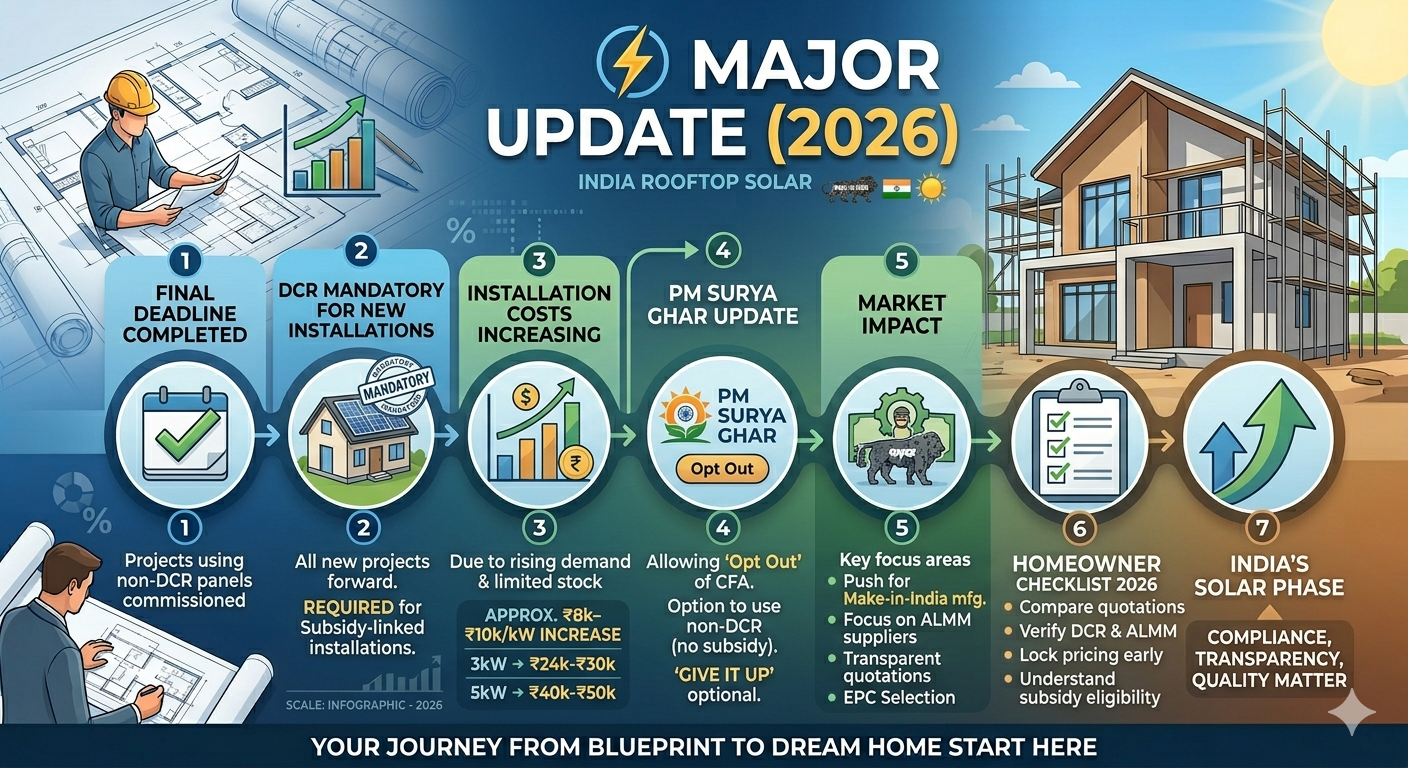
Non-DCR Solar Panels Discontinued from June 1, 2026
Compare solar installation cost through SQFTZ. Explore solar quotations, verified solar installers, solar panel brands, and rooftop solar installation options from one... Read More
Solar Panel for Home: Complete Guide to Cost, Benefits & Installation
Electricity bills are increasing every year, making homeowners look for smarter and more sustainable energy solutions. Installing a solar panel for home... Read More


 by
by 





Join The Discussion